

Written : Dr.Nabil Sameh
Introduction
Reservoir geomechanics coupling represents one of the most critical interdisciplinary concepts in modern petroleum engineering. It refers to the interaction between fluid flow behavior in a reservoir and the mechanical response of the surrounding rock formation. As hydrocarbon production progresses, changes in pore pressure alter the stress state within the reservoir, which in turn affects rock deformation, permeability, porosity, and overall reservoir performance.
Traditionally, reservoir engineering and geomechanics were treated as separate domains. Reservoir engineers focused on fluid flow, pressure depletion, and recovery mechanisms, while geomechanics specialists examined rock strength, stress distribution, and deformation. However, it has become increasingly clear that reservoir performance cannot be fully understood without considering the strong coupling between fluid flow and mechanical rock behavior.
Reservoir geomechanics coupling plays a fundamental role in field development planning, well stability, subsidence prediction, sand production management, and long-term reservoir sustainability. As production continues and pressures decline, rock formations experience stress redistribution that may significantly alter reservoir properties. Therefore, understanding this coupling is essential for safe, efficient, and optimized hydrocarbon extraction.
This article presents a comprehensive theoretical overview of reservoir geomechanics coupling, explaining its principles, mechanisms, impacts, and importance in modern petroleum operations.
Fundamentals of Reservoir Geomechanics
Reservoir geomechanics is concerned with how rocks behave under changing stress conditions. The subsurface is subjected to three primary stresses: vertical stress from overburden weight, and two horizontal stresses resulting from tectonic and geological forces. These stresses determine the structural integrity and stability of the reservoir.
Within the rock matrix, fluids occupy pore spaces. The pressure of these fluids contributes to supporting part of the rock load. When hydrocarbons are produced, the pressure inside the pores decreases. As a result, more load is transferred to the rock skeleton. This shift changes the stress balance within the formation.
The mechanical response of the reservoir rock depends on its properties, including stiffness, strength, elasticity, and fracture susceptibility. Some rocks compress significantly under stress changes, while others remain relatively stable. This behavior directly influences reservoir performance and the effectiveness of production strategies.
Geomechanics coupling occurs because pressure changes are not isolated fluid phenomena. Instead, they create mechanical changes that affect rock deformation and structural stability. These mechanical changes can then influence fluid flow paths, making the reservoir behavior dynamic and interconnected.
Interaction Between Fluid Flow and Rock Mechanics
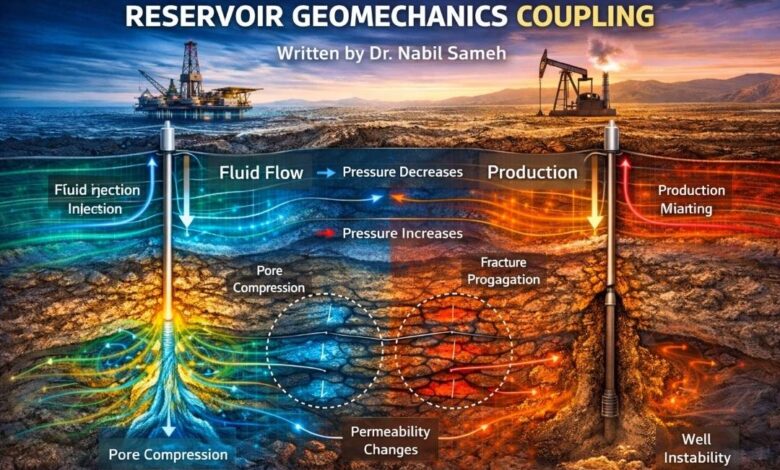
The essence of reservoir geomechanics coupling lies in the two-way interaction between fluid movement and rock deformation. When pressure decreases due to production, the effective stress acting on the rock increases. This causes the rock to compact slightly, reducing pore space and sometimes reducing permeability.
As rock compacts, several outcomes may occur. The reservoir thickness may decrease, porosity may decline, and fluid flow pathways may change. These changes can reduce production efficiency over time.
On the other hand, in some formations, stress redistribution may cause fractures to open or propagate. This may improve permeability locally and enhance fluid flow. Therefore, the mechanical response can either hinder or support production depending on geological conditions.
Fluid injection also plays a role in coupling. When fluids are injected into the reservoir, pore pressure increases. This reduces effective stress and may lead to rock expansion or fracture creation. This process is often beneficial in improving reservoir performance, but it must be carefully controlled to avoid unwanted consequences.
Thus, reservoir geomechanics coupling is not simply a one-directional effect. It is a continuous interaction where pressure changes influence rock behavior, and rock behavior influences fluid movement.
Impact on Reservoir Properties
One of the most important consequences of geomechanics coupling is the alteration of reservoir properties over time. As stress conditions evolve, the internal structure of the rock can change in ways that directly affect production.
Porosity, which determines storage capacity, may decrease as the rock compacts. Even small reductions can significantly affect recoverable reserves. Permeability, which controls how easily fluids flow through the rock, may also decline as pore spaces narrow under increased stress.
In fractured reservoirs, the effect may be more complex. Fractures may close due to stress increase, reducing permeability. Alternatively, new fractures may form in areas where stress concentration occurs. This dynamic behavior makes prediction challenging.
Another important effect is reservoir compaction. As the formation compresses, the overall volume of the reservoir decreases. This can lead to surface subsidence, especially in offshore or shallow reservoirs. While subsidence is a surface manifestation, its origin lies in the mechanical changes occurring within the reservoir.
Geomechanics coupling therefore affects not only fluid flow but also the long-term structural integrity and productivity of the reservoir.
Influence on Well Stability
Well stability is closely linked to geomechanical conditions. When wells are drilled into a reservoir, they disturb the natural stress balance. During production, pressure depletion further modifies stress distribution around the wellbore.
As effective stress increases, the rock surrounding the wellbore may become unstable. This can lead to wellbore collapse, deformation, or failure. These issues can create operational challenges, increase maintenance requirements, and affect production continuity.
In some cases, stress changes may lead to sand production. When reservoir rock loses strength under increased stress, grains may detach and enter the wellbore. This can damage equipment, reduce flow efficiency, and create safety risks.
Injection operations also influence well stability. Increased pore pressure near injection wells may reduce rock strength and promote fracturing. While controlled fracturing may be beneficial, uncontrolled fracture growth can create unintended pathways.
Understanding geomechanics coupling allows engineers to anticipate these risks and design wells that remain stable throughout the life of the reservoir.
Role in Field Development Planning
Reservoir geomechanics coupling has become a key consideration in field development planning. Decisions about well placement, production rates, and injection strategies must take into account the mechanical response of the reservoir.
If production is too aggressive, rapid pressure depletion may lead to excessive compaction and loss of permeability. On the other hand, controlled production may help maintain reservoir integrity and sustain long-term productivity.
Injection strategies are also influenced by geomechanical considerations. Pressure support must be applied in a way that maintains reservoir stability without inducing excessive stress changes.
In large reservoirs, stress changes do not occur uniformly. Some regions may compact more than others, leading to uneven deformation. Understanding this behavior helps in planning well spacing and production sequencing.
Therefore, integrating geomechanics into development planning ensures that both fluid flow and rock stability are considered simultaneously.
Importance in Modern Reservoir Management
As reservoirs mature, the importance of geomechanics coupling increases. Pressure depletion becomes more pronounced, and mechanical effects become more visible. Mature fields often experience compaction, permeability changes, and structural shifts.
Modern reservoir management increasingly relies on integrating geomechanics with reservoir engineering. Monitoring stress evolution helps in predicting production trends, identifying risks, and adjusting operational strategies.
In unconventional reservoirs, geomechanics plays an even more critical role. Production often depends on creating and maintaining fractures. Understanding how stress changes influence fracture behavior is essential for maintaining productivity.
In offshore environments, geomechanics coupling is also important for maintaining platform stability. Reservoir compaction can affect seabed elevation, which in turn influences infrastructure safety.
Thus, geomechanics coupling is not just a theoretical concept but a practical tool for managing reservoirs efficiently and safely over time.
Challenges in Understanding Geomechanics Coupling
Despite its importance, geomechanics coupling remains complex. The subsurface is highly heterogeneous, and rock properties vary from one location to another. Predicting how an entire reservoir will respond to pressure changes is challenging.
Another challenge is the scale of interaction. Mechanical changes occur at both microscopic and reservoir-wide scales. Capturing these interactions requires advanced modeling and careful interpretation.
Data availability is also a limiting factor. Understanding stress distribution requires information from cores, logs, and field observations. Without sufficient data, predictions may carry uncertainty.
Moreover, reservoir behavior evolves continuously. The coupling between fluid flow and rock mechanics is dynamic and requires ongoing monitoring and interpretation.
Nevertheless, continuous advancements in modeling techniques and data integration are improving the ability to understand and manage these complex interactions.
Conclusion
Reservoir geomechanics coupling represents a fundamental aspect of modern petroleum engineering. It highlights the deep connection between fluid flow and the mechanical behavior of reservoir rocks. As hydrocarbons are produced or fluids are injected, pressure changes alter the stress state within the formation. These changes influence rock deformation, porosity, permeability, and structural stability.
Understanding this coupling provides valuable insight into reservoir performance, well stability, compaction behavior, and long-term field management. It supports better decision-making in production planning, injection strategies, and risk mitigation.
As the industry moves toward more complex reservoirs and mature fields, the role of geomechanics becomes increasingly important. Integrating mechanical understanding with reservoir engineering enables a more accurate and realistic representation of subsurface behavior.
Ultimately, reservoir geomechanics coupling enhances the ability to produce hydrocarbons safely, efficiently, and sustainably by recognizing that the reservoir is not just a fluid system, but a dynamic mechanical environment that evolves continuously throughout its productive life.