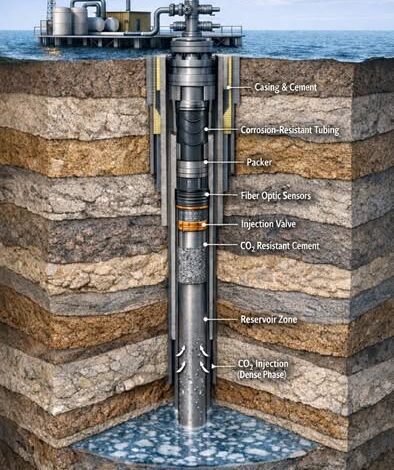
Carbon dioxide (CO₂) injection wells are central to modern energy transition strategies, including Carbon Capture and Storage (CCS), Carbon Capture, Utilization, and Storage (CCUS), and enhanced hydrocarbon recovery projects. While CO₂ injection has been practiced for decades in enhanced oil recovery (EOR), its application for long-term geological storage introduces stricter integrity, containment, and durability requirements.
Completion design for CO₂ injection wells differs significantly from conventional production or water injection wells. The injected fluid—often in a dense phase—presents unique chemical, thermal, and mechanical challenges. Therefore, the completion must ensure:
Long-term well integrity
Zonal isolation
Corrosion resistance
Thermal stability
Mechanical reliability
Monitoring capability
This article presents a comprehensive theoretical framework for completion design in CO₂ injection wells, focusing on engineering considerations, material selection, barrier philosophy, and operational integrity.
CO₂ is typically injected in a dense or supercritical state. Under reservoir conditions, it exhibits properties between those of a gas and a liquid. This behavior results in:
High mobility
Strong density variations with pressure
Significant temperature sensitivity
Rapid pressure or temperature changes can lead to phase transitions, affecting tubing stresses and seal integrity.
2.2 Chemical Reactivity
CO₂ becomes highly corrosive in the presence of water. When dissolved in water, it forms carbonic acid, which can attack:
Carbon steel tubulars
Cement sheaths
Elastomeric seals
This creates a chemically aggressive environment that requires specialized completion materials.
2.3 Geomechanical Considerations
Injection increases pore pressure within the reservoir, potentially altering:
Effective stress
Fault stability
Caprock integrity
The completion must accommodate pressure cycling while maintaining zonal isolation.
3. Completion Philosophy for CO₂ Injection Wells
Completion design follows a multi-barrier approach. The objective is to ensure that CO₂ remains confined within the target formation throughout the injection period and long after abandonment.
3.1 Barrier Concept
A typical CO₂ injection well relies on:
Primary barrier: Tubing string and packer
Secondary barrier: Casing and cement
Tertiary barrier: Geological seal (caprock)
Each barrier must be independently capable of preventing leakage.
3.2 Design Objectives
Prevent CO₂ migration to shallow formations
Protect freshwater aquifers
Resist corrosion for decades
Enable pressure monitoring
Facilitate future plug and abandonment operations
The design life of these wells may exceed several decades, demanding conservative engineering.
4. Tubing and Material Selection
4.1 Corrosion-Resistant Alloys (CRA)
Carbon steel is highly vulnerable to CO₂ corrosion when water is present. Therefore, tubing materials often include:
Corrosion-resistant alloys
Stainless steels
Nickel-based alloys
Material selection depends on:
CO₂ purity
Presence of water
Impurities such as H₂S or oxygen
Temperature and pressure conditions
4.2 Internal Coatings and Liners
Where CRA is economically impractical, alternatives include:
Internal polymer coatings
Metallic cladding
Composite liners
However, long-term performance must be carefully evaluated due to thermal cycling.
5. Packers and Zonal Isolation
5.1 Packer Selection
The packer isolates the injection zone and prevents upward migration. In CO₂ wells, packers must withstand:
Thermal contraction during cold injection
High differential pressures
Chemical exposure
Elastomers used in packers must be compatible with supercritical CO₂, as CO₂ can cause swelling or rapid gas decompression damage.
5.2 Cement Integrity
Cement plays a critical role in:
Supporting casing
Providing zonal isolation
Preventing annular migration
CO₂ can react with conventional Portland cement. Over time, carbonation reactions may alter mechanical properties. To mitigate this:
CO₂-resistant cement blends may be used
Additives can enhance durability
Proper placement techniques are critical
6. Thermal Effects and Mechanical Stresses
6.1 Thermal Shock
Injected CO₂ may be significantly cooler than reservoir temperature. This can lead to:
Tubing contraction
Packer movement
Cement sheath cracking
Completion design must account for thermal cycling throughout injection operations.
6.2 Pressure Cycling
Injection rates may vary depending on operational strategy. Pressure fluctuations introduce:
Fatigue loading
Seal stress variations
Micro-annulus formation risks
Robust mechanical design and conservative safety margins are essential.
7. Annulus Management and Monitoring
7.1 Annulus Pressure Monitoring
Monitoring annulus pressure is critical for early leak detection. Unexpected pressure increases may indicate:
Tubing leaks
Packer failure
Micro-annulus development
Continuous surveillance systems are recommended.
7.2 Fiber Optic and Sensor Integration
Modern CO₂ wells increasingly incorporate:
Downhole temperature sensors
Pressure gauges
Distributed fiber optic systems
These technologies provide real-time insight into injection performance and well integrity.
8. Injection Control and Flow Assurance
8.1 Flow Control Devices
Flow control valves regulate injection rates and prevent sudden pressure surges. Proper rate control reduces:
Reservoir fracturing risk
Caprock stress
Thermal shock
8.2 Impurity Management
Impurities in captured CO₂ streams—such as oxygen, water, sulfur compounds, or nitrogen—can influence corrosion behavior and phase stability. Pre-treatment and dehydration of CO₂ streams significantly improve completion longevity.
9. Integrity Over the Well Life Cycle
9.1 Long-Term Storage Requirements
Unlike temporary injection wells, CCS wells may require:
Monitoring for decades
Extended post-injection care
Predictable abandonment strategies
Completion materials must maintain integrity over very long timeframes.
9.2 Well Abandonment Considerations
Completion design should facilitate safe future plugging. CO₂-resistant cement plugs and corrosion-resistant materials simplify abandonment and reduce long-term leakage risk.
10. Risk-Based Completion Design
Completion planning should follow a structured risk assessment process that evaluates:
Corrosion risk
Mechanical failure risk
Thermal cycling impact
Seal degradation
Caprock integrity
Risk mitigation strategies must be incorporated at the design stage rather than retrofitted later.
11. Integration with Field Development Strategy
CO₂ injection wells are part of broader storage systems that include:
Surface compression facilities
Transportation pipelines
Monitoring wells
Completion design must align with:
Injection rate strategy
Reservoir pressure management
Regulatory storage requirements
Long-term containment objectives
Holistic integration ensures operational efficiency and environmental security.
12. Emerging Technologies in CO₂ Completions
Recent technological developments include:
Advanced elastomers resistant to rapid gas decompression
Self-healing cement systems
Smart completions with automated valves
Digital twin models for integrity forecasting
Advanced corrosion monitoring tools
These innovations aim to improve reliability and reduce long-term risks.
Conclusion
Completion design for CO₂ injection wells represents one of the most technically demanding aspects of carbon storage and utilization projects. Unlike conventional wells, these completions must withstand chemically aggressive environments, thermal cycling, long-term pressure exposure, and extended operational lifespans.
A successful CO₂ injection completion is built upon a multi-barrier philosophy that integrates corrosion-resistant materials, durable zonal isolation systems, robust mechanical design, and continuous monitoring capabilities. Material selection, packer performance, cement durability, and annulus management are not isolated decisions but interdependent elements of a comprehensive integrity framework.
As global decarbonization efforts accelerate, the reliability of CO₂ injection wells becomes critical not only for operational success but also for environmental stewardship and public confidence. Theoretical best practices emphasize conservative design, redundancy, and life-cycle integrity planning.
Ultimately, completion engineering for CO₂ injection wells is not merely about enabling injection—it is about guaranteeing containment, sustainability, and long-term subsurface security.
Written by Dr.Nabil Sameh-Business Development Manager (BDM) at Nileco Company-Certified International Petroleum Trainer-Professor in multiple training consulting companies & academies, including Enviro Oil, ZAD Academy, and Deep Horizon , Etc.-Lecturer at universities inside and outside Egypt-Contributor of petroleum sector articles for Petrocraft and Petrotoday magazines, Etc